Evolut FX+ TAVR was not used within the SMART Trial.
TAVR risks may include, but are not limited to, death, stroke, damage to the arteries, bleeding, and need for permanent pacemaker.
Timely treatment is critical for survival.
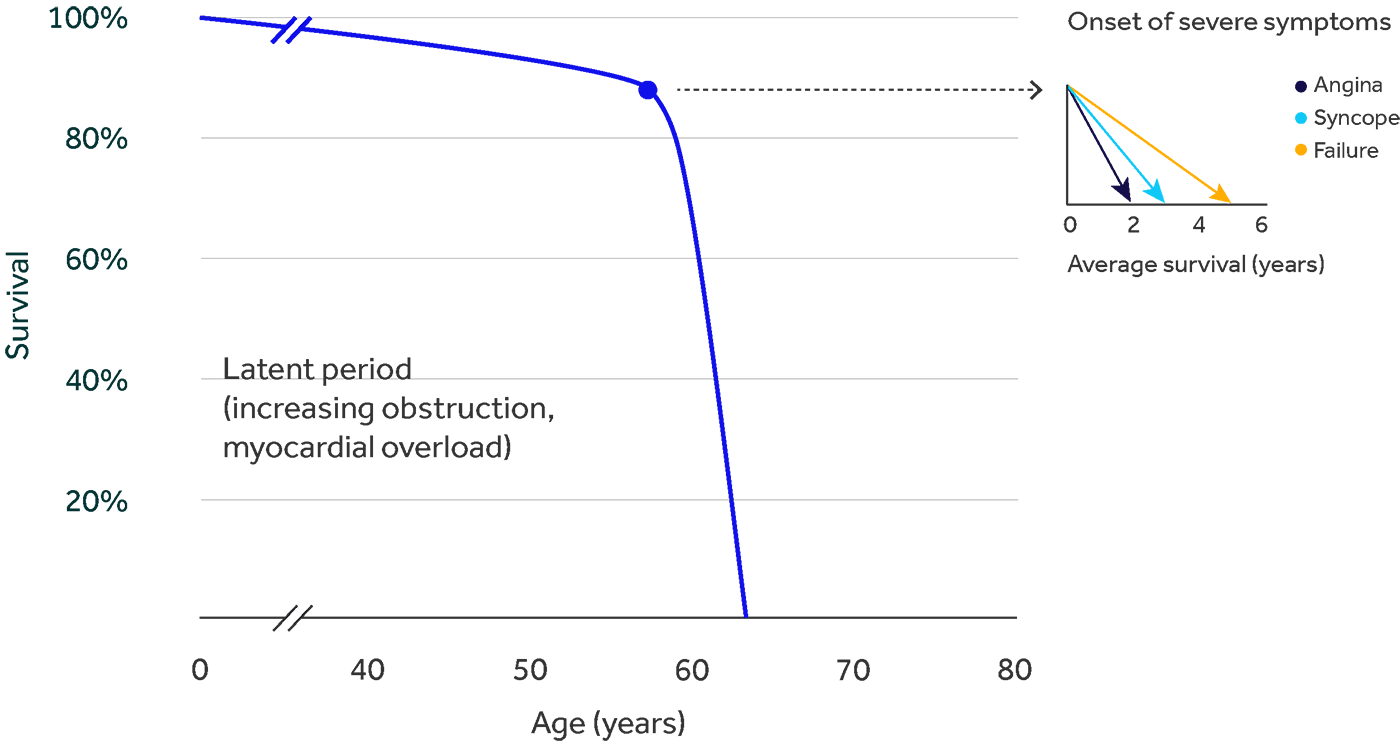
Failure to seek timely treatment for ssAS is a problem that can cost patients their lives. If left untreated, once severe symptoms develop, average patient survival rate at two years is a shockingly low 50%.2
Once severe symptoms begin, survival is cut short2
Detecting aortic stenosis in women can be more challenging.
Diagnosing ssAS can be more challenging in women compared to men, because their symptoms appear differently, and the severity is more frequently underestimated.3,4 Review the common diagnostic challenges of ssAS and identify strategies to improve treatment effectiveness.
Help close the treatment gap for women with aortic stenosis.
When it comes to heart valve disease, research shows that aortic stenosis (AS) impacts women differently than men, which must be addressed to ensure timely treatment and save lives.3,4
The SMART Trial makes a difference.
The SMART Trial is the largest, most rigorous trial to date, to randomize patients to the two most widely used TAVR devices, and the largest TAVR trial to enroll predominantly women.1
When TAVR is the best option, it can make a difference in overall health outcomes compared to baseline.1 Early SMART results support Evolut™ TAVR as proven for women.†,1,7,8
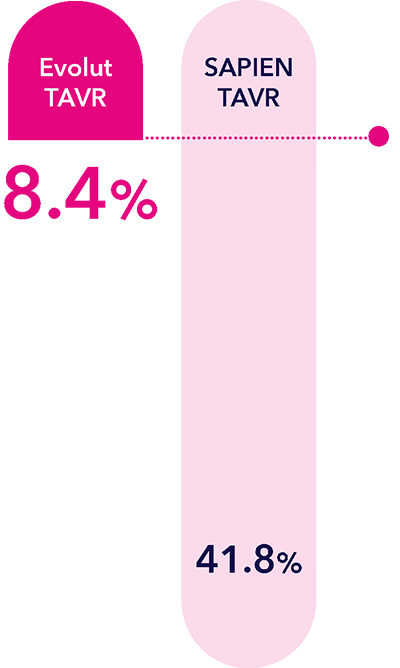
Through 2 years, Evolut TAVR maintains superior valve performance‡ vs. SAPIEN™* in women with small annuli.
Significantly less BVD#,◊
with Evolut TAVR
vs. SAPIEN TAVR in women with small annuli¶,1 p < 0.001
#BVD is bioprosthetic valve dysfunction.
TAVR risks may include, but are not limited to, death, stroke, damage to the arteries, bleeding, and need for permanent pacemaker.
Evolut™ TAVR Valve Performance
Performance matters
Sustained valve performance, as defined as freedom from bioprosthetic valve dysfunction (BVD◊), helps keep your patients alive and out of the hospital.9
If women do receive Evolut™ TAVR treatment, they have superior valve performance‡ compared to the SAPIEN™* platform at 2 years, based on results from the SMART trial.1
Evolut FX+ TAVR was not used within the SMART Trial.
Evolut™ TAVR has a differentiated design.
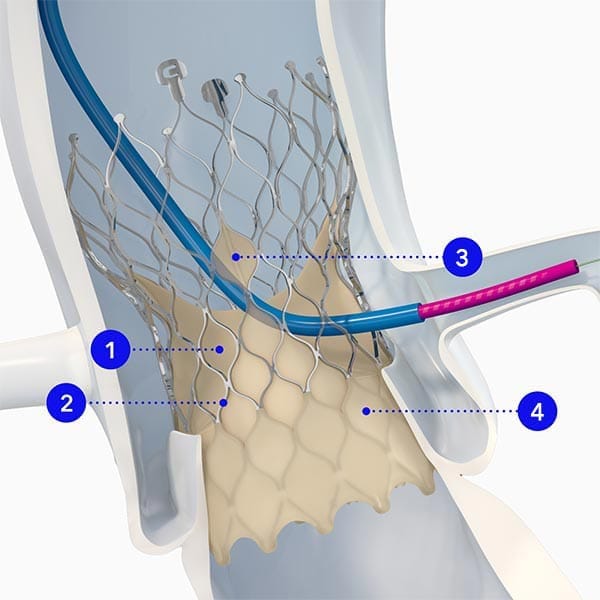
Built on the original CoreValve™ platform, Evolut™ TAVR is engineered with specific design elements to promote sustained valve performance with consistently large EOAs and low gradients over time.10,11
Durability starts with design.
1Supra annular positioning
2Nitinol frame
3Four times larger windows
4External tissue wrap
You’ve chosen TAVR, now choose Evolut™
Valve performance‡ matters from day one.
Evolut™ TAVR delivers superior valve performance‡ in women with small annuli¶ at 2 years vs. SAPIEN™* platform.1
Valve selection matters. Evolut™ TAVR – proven for women.†,1,7,8
TAVR risks may include, but are not limited to, death, stroke, damage to the arteries, bleeding, and need for permanent pacemaker.
Valve performance starts the day of the procedure and continues for a lifetime.
Give your ssAS patients a proven treatment option. When you believe TAVR is the best choice for your patients, you may not be thinking of a particular valve. Maybe you should be.
† Based on the 2-year follow-up results from the SMART clinical trial, which demonstrated differences in valve performance‡ for Evolut compared with SAPIEN* and no differences in safety outcomes. SMART primarily enrolled patients with small annuli, the majority of whom were women.¹ Additional clinical trials evaluating women across a range of annulus sizes have shown lower mortality at 1 year for women treated with TAVR compared with surgical valve replacement,7 with comparable mortality through 5 years in a separate study.8
‡ Valve performance as defined as freedom from bioprosthetic valve dysfunction (BVD) through 24 months. BVD is defined as a composite including any of the following: hemodynamic structural valve dysfunction (mean gradient ≥ 20 mmHg), non-structural valve dysfunction (severe prothesis-patient mismatch or ≥ moderate aortic regurgitation), clinical thrombosis, endocarditis, and aortic valve reintervention.
§ Evolut TAVR is indicated to treat patients who have been diagnosed with symptomatic severe aortic stenosis.
◊ Bioprosthetic Valve Dysfunction12 (BVD) defined as: SVD (mean gradient ≥ 10 mm Hg increase from 30-day/discharge to last echo AND ≥ 20 mm Hg at last echo or new onset/ increase of ≥ moderate intraprosthetic aortic regurgitation), NSVD (severe PPM at 30-day/discharge or severe PVR through 5 years), clinical valve thrombosis, and endocarditis.
¶ In patients with small annuli (area ≤ 430 mm2) in all-comers trial, consisting of majority low surgical risk participants (52.1%).
Bleiziffer S, on behalf of SMART Trial Investigators. Two-year outcomes for Women in the Five-year SMART Trial. Presented at AHA 2025; November 8, 2025; New Orleans, USA.
Ross J Jr, Braunwald E. Aortic stenosis. Circulation. July 1968;38(1 Suppl):61-67.
Nau DP, Ellis JJ, Kline-Rogers EM, Mallya U, Eagle KA, Erickson SR. Gender and perceived severity of cardiac disease: evidence that women are “tougher.” Am J Med. November 2005;118(11):1256–1261.
Iribarren AC, AlBadri A, Wei J, et al. Sex differences in aortic stenosis: Identification of knowledge gaps for sex-specific personalized medicine. Am Heart J Plus. September 2022;21:100197.
Tribouilloy C, Bohbot Y, Rusinaru D, et al. Excess Mortality and Undertreatment of Women With Severe Aortic Stenosis. J Am Heart Assoc. January 5, 2021;10(1):e018816
Rice CT, Barnett S, O’Connell SP, et al. Impact of gender, ethnicity and social deprivation on access to surgical or transcatheter aortic valve replacement in aortic stenosis: a retrospective database study in England. Open Heart. September 2023;10(2):e002373.
Skelding, KA, et al. Transcatheter Aortic Valve Replacement Versus Surgery in Women at High Risk for Surgical Aortic Valve Replacement (from the CoreValve US High Risk Pivotal Trial). Am J Cardiol, 2016. 118(4): p. 560-6.
Wykrzykowska, J. Sex-specific Outcomes at 5 Years in the Evolut Low Risk Trial. Presented at PCR London Valves 2025; November 17, 2025; London, UK
Yakubov SJ, Van Mieghem NM, Oh JK, et al. Impact of Transcatheter or Surgical Aortic Valve Performance on 5-Year Outcomes in Patients at ≥ Intermediate Risk. J Am Coll Cardiol. April 8, 2025;85(13):1419–1430.
Herrmann HC. SMART 2-year data update. Presented at: CRT 2025; March 9, 2025; Washington, D.C.
Forrest, J, Yakubov, S, Deeb, G. et al. 5-Year Outcomes After Transcatheter or Surgical Aortic Valve Replacement in Low-Risk Patients With Aortic Stenosis. JACC. 2025 Apr, 85 (15) 1523–1532.
Adapted from VARC-3: Généreux P, Piazza N, Alu MC, et al. Valve Academic Research Consortium 3: updated endpoint definitions for aortic valve clinical research. J Am Coll Cardiol. 2021;77(21):2717–2746.
 Indications, Safety, and Warnings